

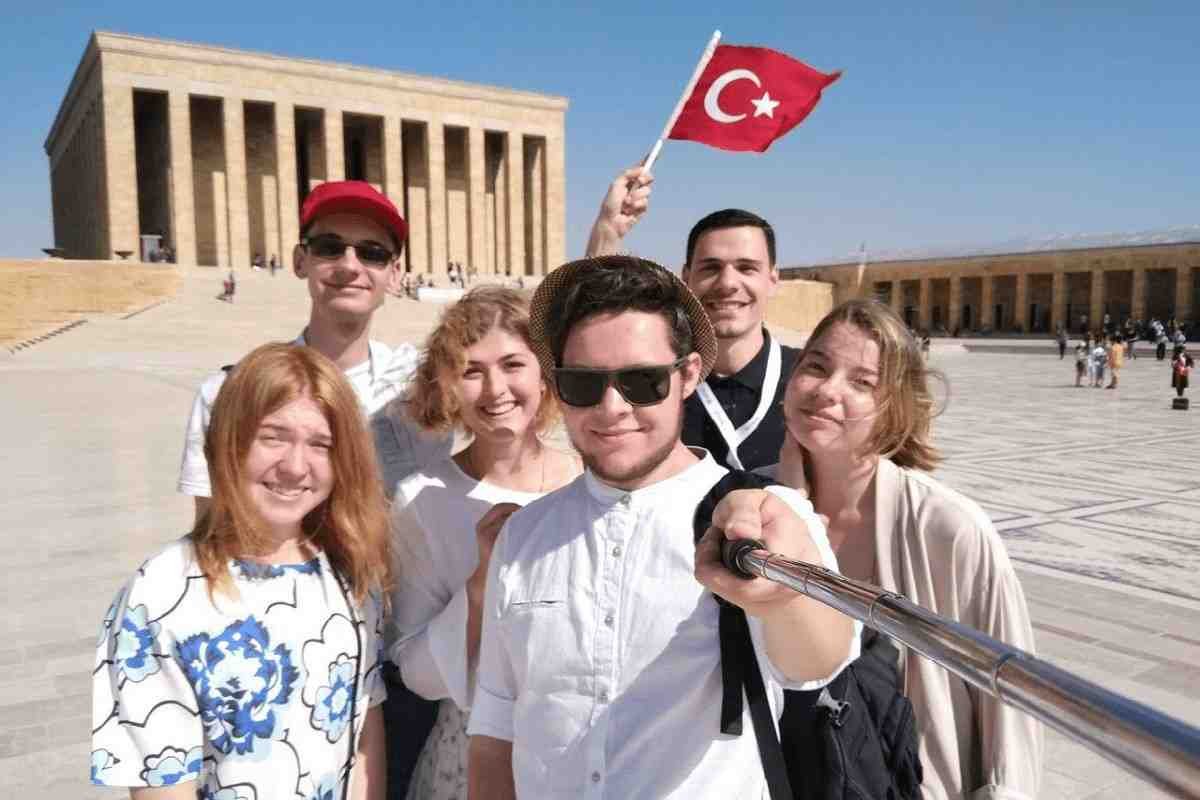
Türkiye hosts students from 198 countries. Most of those students will go home as graduates. Türkiye is also relying on them to go home as friends.
Most countries think about international education in economic terms. This entails considering the number of students, the inflow of cash in the form of tuition, and how much international students would benefit the local economy.Türkiye looks at it differently. The economic return matters. Education-related revenue reached approximately USD 2.87 billion in 2024, this was a fifteenfold increase from the 2012 levels. But economic reasons are not primarily why Türkiye is aiming to become a global education destination. The primary reason is diplomatic influence.
International students are not just revenue. In Türkiye’s strategic framework, they are future ambassadors.
Education as foreign policy
The decision to expand international student intake was not made by a university committee. It was made at the level of national development strategy.
The Turkish government officially designated higher education as a priority export sector in the late 2010s. At the time, the number of overseas students enrolled was around 125,000. Turkish cultural missions and embassies were encouraged to actively promote the enrollment of foreign students. Universities were also urged to form international alliances.
Türkiye’s approach is explicitly internationalist. It fosters not only academic diversity but also intercultural understanding and diplomatic cooperation. In this sense, internationalization is more than an education policy. It is a multidimensional public policy tool that serves peace-building and sustainable development goals.
The nations that are most sought after for student recruitment are not chosen at random. These nations are the ones that are the most strategically important for the country. Türkiye’s international student population comes mainly from Africa, Central Asia, the Middle East, and South Asia. Türkiye is most actively involved in these areas on a diplomatic, economic, and cultural level.
The student flows and the foreign policy priorities point in the same direction.
The scholarship as a diplomatic instrument
Over 15,000 students from 145 countries attend Turkish universities as a result of the Türkiye Scholarships program. More than 150,000 graduates from 184 countries make up their global alumni network. The effort is openly positioned by the administration as a crucial soft power tactic.
The scholarship covers housing, health insurance, complete tuition, monthly stipends, and Turkish language lessons are all covered by the scholarship. It is among the biggest international scholarship programs in the world that is supported by the government. The design makes the strategic reasoning behind it quite evident.
Preference is given to students from low- and middle-income nations. Students from regions Türkiye seeks to influence are awarded regionally oriented awards. Merit is not the only criterion used to award the scholarship. It is mission-based in part.
A Nigerian or Kyrgyz student who spends four years studying in Istanbul, picks up Turkish, makes friends, and goes home with a degree in the language, is more than just a graduate. They serve as a permanent link between two nations. The diplomatic reach becomes apparent when you multiply that by 150,000 alumni from 184 different nations.
The alumni network as a long-term asset
Students are seen as important soft power assets when they return home from their studies in Türkiye . Platforms like the Türkiye Alumni Network and the Türkiye Alumni Associations were established to maintain those ties and encourage additional international cooperation.
In 2040, a student who attended college Istanbul in 2024 might be employed in a ministry back home. Government-to-government agreements are short-lived compared to the friendship formed throughout four years of schooling. It is unique, durable, and challenging to duplicate using any other foreign policy tool.
Large international cohorts produce diverse alumni networks. Graduates holding prominent positions in business, government, and civil society across emerging economies bolster Türkiyee’s long-term diplomatic, cultural, and economic influence. An ongoing source of soft power is the alumni network. It creates bridges that governments can’t develop on their own.
The institutions built to sustain it
Education diplomacy in Türkiye is not limited to university campuses.
Established in 2009, the Yunus Emre Institute promotes Turkish language and culture through more than 90 locations throughout 70 countries. Over 70,000 students are taught at more than 400 institutions and universities across more than 50 countries by the Turkish Maarif Foundation. These institutions significantly broaden Türkiye’s educational reach. In countries where Türkiye has strategic interests, students get familiar with Turkish language, culture, and values well before they even think of applying to a Turkish university.
What this means for India
India and Türkiye have not been traditional education partners.
Bilateral trade between the two countries crossed $10 billion in 2024. Cultural and diplomatic ties are also deepening and the process of institutional academic collaboration is beginning.
For Indian students, the timing is practical. Visa approvals for Türkiye are comparatively straightforward. The cost of a Turkish degree sits well below UK and US alternatives. The post-study network spans 184 countries.
The honest complication
The strategy is coherent; however, its execution has gaps.
There is a problem of low student satisfaction. This is a result of social integration issues, bureaucratic obstacles, and language hurdles. The absence of trustworthy alumni tracking systems is also one recognized issue. A student who struggles to find employment or feels excluded after graduation is hardly an ambassador.
The scholarship only creates opportunities. What happens after the student’s arrival determines whether or not such access leads to long-lasting goodwill.
Türkiye is aware of this. The Council of Higher Education’s 2024-2028 Strategic Plan has shifted its focus from increasing enrollment to improving outcomes. The objective is clearly diplomatic. Whether or not the student experience consistently supports is determined over the following ten years.
Avinav Sharma, Executive Director – Global Partnerships at MSM Unify